

Needle Coke Market Transformative EAF Steel, Battery Gigafactories Race to Reach 11.48 Million Metric Tons by 2035
needle coke market size
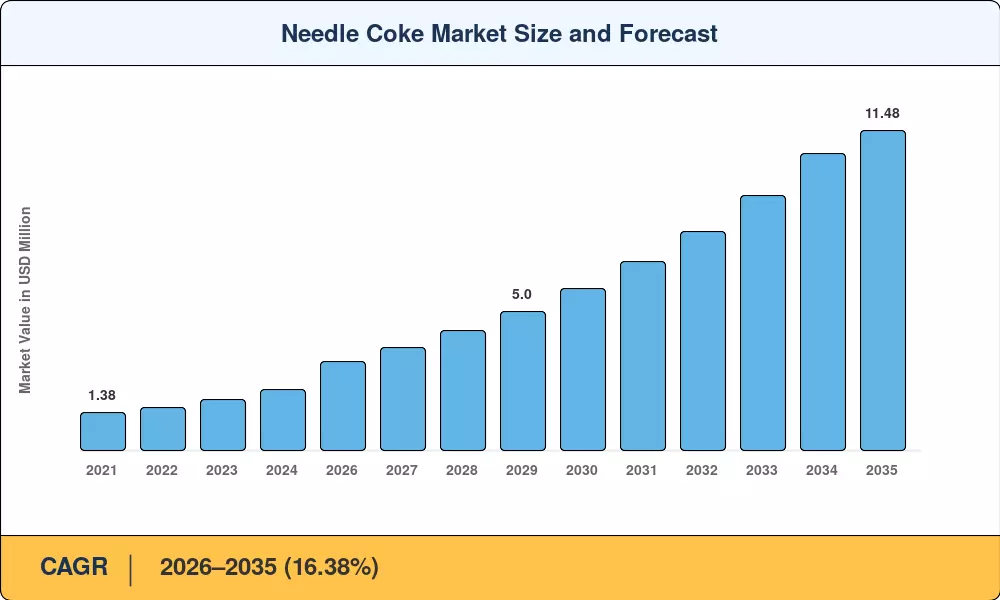
Needle Coke Market register 3.18 million metric tons in 2026 before climbing to 11.48 million metric tons by 2035, expanding at a 16.38% CAGR during 2026–2035.
NY, CA, UNITED STATES, June 8, 2026 /EINPresswire.com/ -- The world's relationship with needle coke once a niche refinery by-product serving a narrow electrode manufacturing base is entering a defining decade. Two structural forces are converging to reposition this specialty carbon material as a linchpin of the global industrial economy: the accelerating decarbonization of steelmaking through electric arc furnaces (EAF), and the relentless gigafactory buildout that is pulling petroleum needle coke into lithium-ion battery anode supply chains. The numbers behind this shift are striking.According to Market Research Future (MRFR), the global Needle Coke Market size reached an estimated 2.71 million metric tons in 2025 and is projected to register 3.18 million metric tons in 2026 before climbing to 11.48 million metric tons by 2035, expanding at a 16.38% CAGR during 2026–2035. These figures make needle coke one of the fastest-growing specialty carbon segments in the global energy and materials transition and one of the most underreported.
This article breaks down what is driving that trajectory, where friction points lie, and which regions and technologies will define the decade ahead, supported by data from authoritative government bodies, international agencies, and energy research institutions.
Ask for Sample PDF https://www.marketresearchfuture.com/sample_request/28656
Key Players in the Market
The competitive landscape of the global Needle Coke Market exhibits medium concentration, with an estimated top-five producer share of 55–62%. Vertical integration from refinery coking through calcination to graphite electrode manufacturing is the dominant competitive strategy.
Prominent companies cited across market reports include Phillips 66 (Seadrift Coke, United States), CNPC Jinzhou Petrochemical (China), Mitsubishi Chemical (Japan), Indian Oil Corporation (IOCL, India), JFE Chemical (Japan), Petrocokes Japan, GrafTech International, Baosteel Resources (China), C-Chem Co., Ltd. (Japan), and Sinopec Maoming (China). These companies compete on calcination technology, CTE consistency, digital monitoring capability, and geographic supply chain positioning.
The EAF Steel Engine: The Market's Most Durable Demand Driver
No single factor explains the needle coke market's growth momentum more than the global shift to electric arc furnace steelmaking. EAF production is cleaner, more flexible, and increasingly mandated by national decarbonization policy and every new EAF shop requires a secured petroleum needle coke graphite electrode supply, typically locked in two to three years ahead of hot commissioning.
According to the World Steel Association, global EAF steel production reached 548.4 million tonnes in 2024, representing a 29.1% share of total global crude steel output of 1.885 billion tonnes up from 28.6% a year earlier. The United States leads in EAF penetration, with 71.8% of its steel produced in electric arc furnaces. Countries including India, Iran, and Egypt each exceed 50% EAF share, and the European Union reached 44.4% in 2024.
The trajectory ahead is even more consequential. S&P Global Market Intelligence forecasts close to 800 million tonnes of EAF steel output by 2035, a near-50% increase over 2024 volumes raising EAF's share of total steel production from 29% to approximately 40% over the decade. This structural ramp provides a durable demand floor for ultra-high power (UHP) electrode needle coke for years to come.
India's policy momentum adds a critical emerging-market dimension. Under the Ministry of Steel's National Steel Policy, India is targeting an installed steelmaking capacity of 300 million tonnes (MT) by 2030 up from approximately 220 MTPA in FY 2025–26. India is already the world's second-largest crude steel producer, and the government's Green Steel Initiative with Tata Steel commissioning a Rs 3,200 crore scrap-based EAF green steel plant at Ludhiana in 2025 signals that the country's EAF buildout is accelerating in earnest.
China, meanwhile, has been executing a scrap-steel circular economy directive that sanctioned 28 new EAF furnace projects between 2023 and 2025. China's Ministry of Industry and Information Technology has set targets for EAF-based capacity to reach 15% of crude steel production by end-2025 and over 20% by 2028–2030 a shift that, at China's production scale, represents tens of millions of additional tonnes of EAF output demanding graphite electrode supply.
The Battery Anode Corridor: A Parallel Demand Revolution
Beyond the steel sector, needle coke is being pulled into an entirely different demand corridor: synthetic graphite anode manufacturing for lithium-ion batteries. This is the market's fastest-growing application, forecast by MRFR at a 23.8% CAGR through 2035 outpacing even the robust growth in graphite electrodes.
Committed global lithium-ion cell manufacturing capacity exceeded 7.2 TWh by late 2024, with needle coke Li-ion anode graphite specifications now embedded in qualification protocols at CATL, LG Energy Solution, and Samsung SDI. Synthetic graphite anode plants require calcined petroleum needle coke with coefficient of thermal expansion (CTE) values below 1.0 × 10⁻⁶/°C a specification that channels premium-grade material away from graphite electrode producers and into battery supply chains.
The United States is directly incentivizing domestic needle coke-to-anode conversion through the Inflation Reduction Act's Section 45X Advanced Manufacturing Production Credit, which provides a 10% production tax credit for domestically manufactured electrode active materials including synthetic graphite anode materials and explicitly qualifies graphite purified to a minimum purity of 99.9% graphitic carbon by mass as an applicable critical mineral. The IRS finalized regulations under Section 45X in October 2024, and the Joint Committee on Taxation projects taxpayers will claim USD 87.3 billion in total Advanced Manufacturing Production Credits by 2028.
This policy framework has catalyzed over USD 1.2 billion in anode-material capacity announcements in the United States since 2023, creating a domestic demand corridor for petroleum needle coke that did not meaningfully exist five years ago.
Ask for Customization https://www.marketresearchfuture.com/ask_for_customize/28656
Market Segmentation: What the Breakdown Reveals
By Product Type
Petroleum-based needle coke held approximately 90% of the global Needle Coke Market in 2025, reflecting the industry's deep reliance on refinery integration along the U.S. Gulf Coast and in China's Shandong province. Integrated oil-based producers control both the feedstock fluid catalytic cracking (FCC) decant oil and the calcination step in a single value chain. Refiners in these corridors have invested over USD 3.5 billion since 2020 in ultra-low-sulfur upgrading units that improve petroleum needle coke graphite electrode quality consistency.
Coal-tar pitch-based needle coke, while representing the smaller share, is forecast to grow at a 14.2% CAGR through 2035, led by steelmakers seeking dual-sourcing resilience and reduced dependence on petroleum pathways. Japanese producers such as Mitsubishi Chemical and JFE Chemical have refined coal-tar distillation processes to achieve CTE values comparable to petroleum routes, opening new applications for coal tar needle coke in EAF steel electrode manufacturing and specialty carbon products.
By Application
Graphite electrodes commanded roughly 67% of 2025 consumption within the Needle Coke Market, underpinned by ultra-high power (UHP) electrode needle coke demand in EAF mills globally. As EAF furnace power ratings exceed 150 MVA, electrode requirements are intensifying with UHP grades requiring CTE below 0.9 × 10⁻⁶/°C creating a quality-driven premium layer within this already-dominant segment.
Lithium-ion batteries recorded the fastest application-level growth, at a 23.8% CAGR through 2035. The gigafactory commissioning rate doubled between 2022 and 2024, and synthetic graphite producers are now signing multi-year offtake agreements to lock in calcined needle coke supply a shift that is formalizing the battery anode corridor as a permanent structural feature of needle coke demand.
Other applications including nuclear graphite and specialty carbon products accounted for approximately USD 52 million in 2025 market value.
Key Restraints: Where the Market Faces Friction
Feedstock Price Volatility
FCC decant oil the primary petroleum needle coke graphite electrode feedstock experienced a 34% spot-price swing during 2023–2024 as refinery utilization fluctuated. Oil-based needle coke producers with limited backward integration face margin compression during price spikes, which can delay capacity expansion decisions. According to the U.S. Energy Information Administration, long-term offtake contracts indexed to decant oil benchmarks can dampen spot-price volatility by roughly 40% compared to open-market transactions, but securing such contracts requires production-scale credibility that smaller producers often lack.
Environmental Compliance Costs
Delayed coking and calcination facilities face tightening SO₂ and PAH emission standards, particularly under China's Blue Sky regulations and the EU's Industrial Emissions Directive revision. Retrofit costs for scrubber and baghouse systems can exceed USD 40 million per facility, raising competitive barriers for smaller coal tar needle coke producers.
Graphite Recycling Substitution
Pilot-scale programs in Japan and Germany are recovering synthetic graphite from spent electrodes and end-of-life battery anodes, with recovery yields reaching 72% purity in laboratory settings. While commercialization at a scale sufficient to displace more than 5% of virgin demand is unlikely before 2032, a successful scale-up would partially offset virgin needle coke demand and moderate long-run pricing.
Emerging Opportunities: The Next Growth Levers
Synthetic Graphite Anode Localization in North America
The U.S. Inflation Reduction Act's Section 45X vital minerals sourcing criteria provide direct incentive for domestic needle coke-to-anode conversion. Section 45X provides a 10% production tax credit on the cost of producing electrode active materials including anode materials and qualifying graphite as a critical mineral. This framework has the potential to catalyze a projected cumulative capital deployment of USD 2.8 billion in domestic anode-material capacity through 2030.
Premium UHP Electrode Specification Tightening
As EAF furnace power ratings exceed 150 MVA, electrode requirements are creating demand for ultra-high power UHP electrode needle coke with CTE below 0.9 × 10⁻⁶/°C. Producers consistently achieving sub-0.9 CTE can command pricing premiums of 12–18% over conventional grades, improving unit margin significantly.
Emerging-Market EAF Steel Buildout
India, Indonesia, and Brazil present a combined pipeline of over 35 million tonnes of additional EAF steel capacity through 2032, creating greenfield petroleum needle coke graphite electrode demand in regions currently dependent on imports. India's Ministry of Steel confirmed in May 2026 that total steel capacity stood at approximately 220 MTPA, on track toward the National Steel Policy target of 300 MTPA by 2030 with EAF and induction arc furnace (IAF) routes expected to represent 35–40% of that expanded capacity.
Coal-Tar Pitch Route Diversification
Japanese trading houses committed over USD 500 million in 2024 to coal-tar pitch distillation capacity in India and Vietnam, diversifying supply away from petroleum-dependent pathways. This investment reduces systemic supply-chain risk and expands the geographic footprint of needle coke production in Asia-Pacific.
Digital Process Optimization
Real-time calcination monitoring using AI-driven thermal imaging is reducing off-spec production by up to 22% in early-adopter facilities. Producers packaging process-analytics data as licensed optimization platforms can generate recurring revenue beyond commodity sales opening a new business model dimension within the market.
Read More Premium Research Insights https://www.marketresearchfuture.com/reports/needle-coke-market-28656
Future Outlook: Three Structural Themes Through 2035
Steel Decarbonization as a Structural Demand Floor
The IEA's Net Zero Emissions pathway projects global EAF steel output reaching 50% of total crude steel by 2040, implying a sustained pull on graphite electrode feedstocks for over 15 years. The World Steel Association's data shows that scrap-based EAF produces only 0.68 tonnes of CO₂ per tonne of crude steel, versus 2.33 tCO₂/tcs for the blast furnace-BOF route giving regulators a compelling reason to continue mandating the EAF transition. This ensures that petroleum needle coke graphite electrode demand remains structurally elevated, with incremental supply needing to come online every 18–24 months to avoid bottlenecks.
Battery Anode Evolution: Near-Term Lock-In Despite Long-Term Chemistry Shifts
As silicon-carbon composite anodes gain traction post-2030, pure synthetic-graphite anode demand may eventually plateau but near-term capacity commitments still lock in needle coke Li-ion anode graphite consumption through 2032 at minimum. Producers investing in high-purity calcination today will retain first-mover advantages even as anode chemistry evolves.
ESG Transparency and Scope 3 Disclosure
Mandatory Scope 3 carbon disclosure under the EU's Corporate Sustainability Reporting Directive (CSRD) and the SEC's climate-risk rules will compel electrode and battery producers to audit upstream coking emissions. Needle coke calcination process operators that achieve verified emission reductions will gain preferential supplier status, reshaping competitive dynamics rewarding scale, integration, and environmental compliance investment.
More Related Research Insights:
https://www.marketresearchfuture.com/reports/pet-coke-market-5349
https://www.marketresearchfuture.com/reports/petroleum-coke-market-6566
https://www.marketresearchfuture.com/reports/foundry-coke-market-8214
https://www.marketresearchfuture.com/reports/us-pet-coke-market-20118
https://www.marketresearchfuture.com/reports/graphite-electrode-market-11150
Larry Wilson
WantStats Research And Media Pvt. Ltd.
+1 855-661-4441
email us here
Visit us on social media:
LinkedIn
Facebook
YouTube
X
Legal Disclaimer:
EIN Presswire provides this news content "as is" without warranty of any kind. We do not accept any responsibility or liability for the accuracy, content, images, videos, licenses, completeness, legality, or reliability of the information contained in this article. If you have any complaints or copyright issues related to this article, kindly contact the author above.
