

Endoscopy Devices Market to reach USD 84.55 Billion by 2035 at 7.10% CAGR
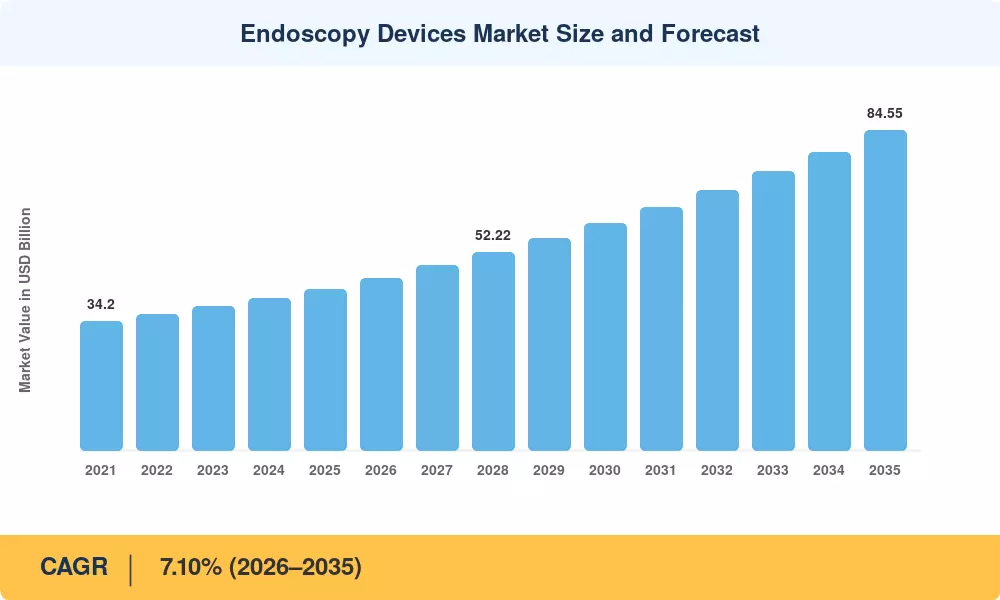
Endoscopy Devices Market Size
Endoscopy Devices Market to Surge from USD 45.52B in 2026 to USD 84.55B by 2035-By CMS Colonoscopy Cost-Sharing Elimination, AI-Guided Detection Platforms
NY, CA, UNITED STATES, July 16, 2026 /EINPresswire.com/ -- As per Market Research Future, the global Endoscopy Devices Market size to reach USD 84.55 Billion by 2035 from USD 45.52 Billion in 2026, at a CAGR of 7.10% during the forecast period 2026--2035. The market base was estimated at USD 42.50 Billion in 2025.The 7.10% CAGR---anchored by structural procedural demand rather than discretionary healthcare spending---is driven by three converging forces: the U.S. Centers for Medicare & Medicaid Services (CMS) decision in 2024 to eliminate cost-sharing for screening colonoscopies, the rapid deployment of AI-enabled adenoma detection software that is pushing hospitals to upgrade aging visualization towers ahead of schedule, and infection-control mandates that are accelerating single-use scope adoption as the FDA issued twelve separate safety communications on reprocessing contamination risks between 2024 and 2026.
National governments and multilateral health organizations are amplifying this momentum. The CMS decision, effective January 2024, removed out-of-pocket costs for Medicare beneficiaries undergoing screening colonoscopies, including procedures where a polyp is found and removed. Early utilization data from the American Gastroenterological Association indicates a 14% rise in scheduled colonoscopies within the first nine months of implementation, directly increasing consumable and capital equipment pull-through across the Endoscopy Devices Market.
Request A Free Sample:
https://www.marketresearchfuture.com/sample_request/1967
Key Market Trends & Growth Drivers
Elimination of Patient Cost-Sharing for Screening Colonoscopies
The CMS decision, effective January 2024, removed out-of-pocket costs for Medicare beneficiaries undergoing screening colonoscopies, including procedures where a polyp is found and removed. Early utilization data from the American Gastroenterological Association indicates a 14% rise in scheduled colonoscopies within the first nine months of implementation, directly increasing consumable and capital equipment pull-through across the Endoscopy Devices Market. A single policy ecosystem that converted a procedure-limited market into one with a structural preventive screening tail. CMS reimbursement for screening colonoscopies under the hospital outpatient prospective payment system has driven adoption in academic medical centers, while community gastroenterology networks increasingly prescribe screening protocols to manage endoscopy suite capacity. The US dominates through a combination of high procedural volumes, robust payer coverage, and rapid AI-enhanced detection adoption.
Canada contributes through provincial wait-time reduction initiatives at 7.85% CAGR, while Mexico is growing at steady pace on IMSS hospital equipment modernization at USD 1.02 Billion in 2025. North America's leadership rests on reimbursement depth and the structural screening segment created by expanded CMS compliance mandates and value-based care contracts.
AI-Guided Detection Platforms
Legacy standard-definition endoscope platforms installed between 2012 and 2018 are now being retired in favor of 4K-capable systems bundled with cloud-based image archiving. Computer-aided detection (CADe) and computer-aided diagnosis (CADx) modules received more than 18 FDA 510(k) clearances between 2022 and 2025, with clinical trials demonstrating a 30--40% improvement in adenoma detection rates versus unaided white-light endoscopy. Hospitals integrating these platforms are replacing entire visualization stacks to ensure software-hardware compatibility, creating a pull-through effect valued at an estimated USD 2.1 Billion in incremental equipment sales by 2028.
The convergence of diagnostic AI modules with 4K CMOS sensor platforms is creating theranostic-like workflows that personalize endoscopic detection at scale. Olympus and Fujifilm have committed more than USD 1.5 billion in AI module integration from 2022 to 2025. By 2030, an estimated 40% of newly diagnosed colorectal lesions will undergo AI-enhanced detection followed by matched therapeutic intervention, creating a diagnostic-therapeutic revenue loop. In the US, AI platform adoption is accelerating as academic medical centers build cloud-based image archiving capacity.
Infection-Control Mandates and Single-Use Adoption
Between 2024 and 2026, the FDA issued twelve safety communications citing contamination events linked to reprocessed duodenoscopes, driving hospital infection-prevention committees to mandate single-use alternatives for high-risk procedures. Although per-procedure costs for disposable scopes remain 35--50% higher, the total cost of ownership---including reprocessing labor, sterilant chemicals, and liability exposure---narrows the gap to approximately 12% on a per-case basis.
The move from reusable to single-use devices---as seen with Ambu's aScope single-use bronchoscopes and duodenoscopes---decreases reprocessing burden from 30--60 minutes to zero per procedure. Ambulatory surgical centers and community gastroenterology clinics are seeing a rising preference for single-use forms due to lower operating costs and higher patient throughput.
This convenience-driven adoption is expected to open up incremental income for the Endoscopy Devices Market in the absence of reprocessing infrastructure. China's National Healthcare Security Administration added upper-GI screening coverage in its 2025 National Cancer Screening Program, instantly extending endoscopy access to over 1.3 billion insured lives. India's Ayushman Bharat scheme and China's National Cancer Screening Program together make gastrointestinal screening accessible to more than 900 million previously underserved individuals.
Ask for Customization:
https://www.marketresearchfuture.com/ask_for_customize/1967
Market Segment Insights
BY DEVICE TYPE
Endoscopes (Rigid & Flexible): Dominant segment with ~46.2% revenue share in 2025. Reflecting entrenched physician familiarity with flexible gastroscopes and colonoscopes. The installed base of flexible gastroscopes and colonoscopes exceeds 2.8 million units globally, and average replacement cycles have shortened from seven years to fewer than five as AI-software compatibility requirements render older optics obsolete. Hospital procurement teams treat it as a default first-line category, and established pricing has enabled broad adoption even in cost-sensitive emerging markets.
Visualization Equipment: Fastest-growing device segment at 8.90% CAGR (2026--2035). Driven by 4K CMOS sensor platform upgrades and expanding AI module compatibility. Olympus's EVIS X1 and Fujifilm's ELUXEO 700 series generated over USD 1.3 Billion in 2024 revenue, and pipeline AI-integrated visualization towers targeting outpatient and ASC settings could double the segment's addressable population by 2030. The convergence of diagnostic AI modules with 4K imaging is creating personalized detection workflows at scale.
Endoscopic Operative Devices: USD 12.35 Billion in 2025. Therapeutic procedure expansion sustains residual demand across laparoscopic and arthroscopic applications.
Other Device Types: Growing segment at steady pace. Insufflation, irrigation, and ancillary systems sustain demand for integrated tower components.
BY APPLICATION
Gastrointestinal: Dominant application with ~59.4% revenue share in 2025. Approximately 19 million endoscopic procedures performed annually across hospitals and ASCs in the US alone, making gastrointestinal screening a near-universal component of preventive care pathways. The inherent volume of colorectal cancer prevention programs drives sustained dual-channel demand for endoscopy devices.
Laparoscopy: Fastest-growing application segment at 9.50% CAGR (2026--2035). Reflecting robotic-assisted oncologic surgery growth. An estimated 1.2 million robotic-assisted laparoscopic procedures expected globally by 2030 create a larger prevalent population requiring sustained operative device utilization.
Arthroscopy: USD 3.18 Billion in 2025. Sports-medicine procedure volume anchors this segment.
Other Applications: Growing segment at 5.80% CAGR (2026--2035). ENT, urology, and gynecology expansion drives demand for specialized rigid and flexible scopes.
BY USABILITY
Reprocessed / Reusable Devices: Dominant usability segment with ~85.5% revenue share in 2025. Hospital infusion center infrastructure dominates volume, channeling routine endoscopy supply. Reusable flexible gastroscopes and colonoscopes delivered in hospital outpatient settings anchor this segment.
Single-Use Devices: Fastest-growing usability segment at 11.75% CAGR (2026--2035). Infection-control mandates and FDA contamination alerts drive demand. Single-use duodenoscopes and bronchoscopes reduce reprocessing burden from 30--60 minutes to zero, enabling endoscopy in community clinics lacking sterilization capacity.
BY END USER
Hospitals: Largest segment with ~52.3% share in 2025. Complex therapeutic procedure concentration and comprehensive gastroenterology service lines dominate volume. Hospitals remain the primary delivery site for advanced endoscopic interventions due to anesthesia infrastructure, specialized nursing, and emergency backup requirements.
Ambulatory Surgical Centers: Fastest-growing end-user segment at 10.45% CAGR (2026--2035). Site-neutral payment reform and outpatient shift drive demand as single-use and compact systems reduce the need for supervised reprocessing. ASCs and community gastroenterology clinics increasingly prescribe office-based endoscopy options to manage hospital suite capacity.
Academic Medical Centers: USD 7.65 Billion in 2025. Training programs and clinical-trial infrastructure drive demand for next-generation platforms, functioning as reference sites that influence community-hospital purchasing decisions.
Read Detailed Insights:
https://www.marketresearchfuture.com/reports/endoscopy-devices-market-1967
Regional Outlook
North America -- Dominant Market (~43.8% Share, 2025)
The United States generates approximately 82.5% of North American Endoscopy Devices Market revenue, driven by the CMS colonoscopy cost-sharing removal, commercial insurance coverage of AI-enhanced detection platforms as first-line screening tools, and broad reimbursement for endoscopy regimens---a single policy ecosystem that converted a procedure-limited market into one with a structural preventive screening tail. CMS reimbursement for screening colonoscopies under the hospital outpatient prospective payment system has driven adoption in academic medical centers, while community gastroenterology networks increasingly prescribe screening protocols to manage endoscopy suite capacity. The US dominates through a combination of high procedural volumes, robust payer coverage, and rapid AI platform adoption.
Canada contributes through provincial wait-time reduction initiatives at 7.85% CAGR, while Mexico is growing at steady pace on IMSS hospital equipment modernization at USD 1.02 Billion in 2025. North America's leadership rests on reimbursement depth and the structural screening segment created by expanded CMS compliance mandates and value-based care contracts.
Europe -- Second Largest (USD 11.90 Billion, 2025)
Europe's Endoscopy Devices Market reflects divergent national strategies---Germany leads regionally with DRG reimbursement incentives for outpatient endoscopy, contributing 24.3% of regional share, while the UK historically used selective endoscopy targeting before broadening coverage through the NHS Endoscopy Transformation Programme at 7.40% CAGR. France contributes ~15.5% of regional share through ARS regional equipment standardization. Italy contributes steady growth on national screening program scale-up. Spain is growing at steady pace on autonomous community procurement tenders.
Harmonization pressure from the EU Medical Device Regulation (MDR 2017/745) is gradually narrowing these differences, lifting baseline demand across the region. The European Commission's MDR transition mandates equitable access to medical devices, including endoscopy equipment across all member states. The Nordic countries hold ~7.4% of regional share on centralized purchasing and quality registries. Russia contributes USD 0.68 Billion on federal healthcare modernization program. Centralized health technology assessment bodies---NICE, G-BA, and HAS---have progressively widened reimbursement for endoscopy across screening and therapeutic indications.
Asia-Pacific -- Fastest-Growing Region (9.15% CAGR, 2026--2035)
Asia-Pacific is the engine of the Endoscopy Devices Market. China holds the largest regional share with ~34.8% of regional revenue, driven by National Cancer Screening Program expansion---adding upper-GI and colorectal screening for adults aged 40--74 across 600 county-level hospitals in 2025, instantly extending endoscopy access to over 1.3 billion insured lives. India is growing at 10.20% CAGR on the back of Ayushman Bharat coverage broadening. Japan contributes USD 2.45 Billion through NHI pricing for next-gen platforms at steady pace, with procedural volumes per capita among the world's highest reflecting both demographic aging and deeply embedded preventive care culture. South Korea is growing at 9.30% CAGR on NHIS preventive screening mandate.
ASEAN economies hold ~9.6% of regional share on public--private partnership hospital construction. The rest of Asia-Pacific is growing at 8.10% CAGR on medical tourism for endoscopy. The region's combined contribution anchors the global volume base for endoscopy device demand. Asia-Pacific represents the highest-growth opportunity, driven by a confluence of rising cancer incidence, urbanization, and government investment in screening infrastructure.
Middle East & Africa -- Emerging Opportunity (Steady Growth, 2025)
The Middle East & Africa is bifurcated between well-funded Gulf states and resource-constrained Sub-Saharan nations. Saudi Arabia leads the region with Vision 2030 health cluster development, contributing ~31.2% of regional share---22 new hospital complexes equipped with integrated endoscopy suites. The UAE is growing at 7.95% CAGR on medical tourism and JCI-accredited facility growth. South Africa contributes USD 0.18 Billion on NHI pilot program equipment grants.
Egypt is growing at 6.40% CAGR on Universal Health Insurance System rollout. NGO-supported oncology access programs underpin demand across the rest of the region. Diagnostic infrastructure gaps in LMICs remain a restraint---real-world evidence from the FDA safety communications indicates contamination events of 1--5% among patients receiving reprocessed flexible endoscopes beyond standard cycles. These risks lead to treatment postponement and physician reluctance to initiate early screening regimens, indirectly narrowing the Endoscopy Devices Market addressable population.
Competitive Landscape and Recent Developments
The Endoscopy Devices Market displays medium concentration, with the top five companies holding an estimated 58--64% combined revenue share. The Herfindahl-Hirschman Index sits in the 1,200--1,500 range, reflecting a mix of multinational medical device leaders and specialized visualization developers. Patent expirations and single-use entrants are gradually fragmenting reusable segments, though pipeline innovation in AI-integrated platforms sustains competitive moats for first-movers.
The competitive landscape is stratified between flexible endoscope pioneers serving global GI markets, visualization system expansion specialists capturing AI module tenders, and single-use scope developers consolidating the disposable segment.
KEY COMPANIES AND RECENT MILESTONES
Olympus Corporation (2024--2025): Maintains leadership with flexible endoscopes and EVIS X1 visualization, commanding ~18--22% of global Endoscopy Devices Market revenue. Dominant in GI scopes; AI module integration anchors a strong global franchise. Premium visualization positioning in specialty segments offsets price compression in competitive markets.
Medtronic plc (2024--2025): GI Genius AI module and surgical stapling reinforce cross-selling AI detection into installed base positioning, holding ~8--11% of global revenue. The company benefits from the structural AI tail created by expanded CADe/CADx pipeline investment.
Boston Scientific Corporation (2024--2025): SpyGlass cholangioscopy and stents reinforce the therapeutic device specialist positioning, holding ~7--10% of global revenue.
Johnson & Johnson (Ethicon) (2024--2025): Harmonic energy devices and trocars reinforce the laparoscopic operative device breadth positioning, holding ~6--9% of global revenue.
Karl Storz SE & Co. KG (2024--2025): Rigid endoscopes and IMAGE1 S 4K platform reinforce the visualization leadership in ENT and urology positioning, holding ~5--8% of global revenue.
Future Outlook: 2026--2035
By 2030, precision AI-integrated endoscopy will become the operating system of gastrointestinal and therapeutic procedure management. The convergence of companion diagnostics and targeted AI detection will reshape the Endoscopy Devices Market through the late 2020s. By 2030, an estimated 40% of newly diagnosed colorectal lesions will undergo AI-enhanced detection followed by matched therapeutic intervention, creating a diagnostic-therapeutic revenue loop. The FDA's 18+ CADe/CADx clearances ensure domestic AI module supply scales alongside clinical demand. Machine-learning models that integrate genomic, proteomic, and imaging biomarkers can recommend optimal sequencing of screening, surveillance, and therapeutic interventions for individual patients. Start-ups have raised over USD 800 million in venture funding for endoscopy decision-support tools since 2023.
More Related Research Insights:
https://www.marketresearchfuture.com/reports/accountable-care-solution-market-42042
https://www.marketresearchfuture.com/reports/achromatopsia-treatment-market-34765
https://www.marketresearchfuture.com/reports/acoustic-medicine-ultrasound-therapy-market-34319
https://www.marketresearchfuture.com/reports/acute-otitis-media-treatment-market-42052
https://www.marketresearchfuture.com/reports/ai-in-epidemiology-market-42073
https://www.marketresearchfuture.com/reports/ai-powered-clinical-decision-support-market-42071
https://www.marketresearchfuture.com/reports/airway-stents-market-40694
https://www.marketresearchfuture.com/reports/alprazolam-powder-market-42054
https://www.marketresearchfuture.com/reports/ambulance-stretchers-market-42005
https://www.marketresearchfuture.com/reports/ambulatory-surgery-centers-market-65898
Larry Wilson
WantStats Research And Media Pvt. Ltd.
+1 855-661-4441
email us here
Visit us on social media:
LinkedIn
Facebook
YouTube
X
Legal Disclaimer:
EIN Presswire provides this news content "as is" without warranty of any kind. We do not accept any responsibility or liability for the accuracy, content, images, videos, licenses, completeness, legality, or reliability of the information contained in this article. If you have any complaints or copyright issues related to this article, kindly contact the author above.
